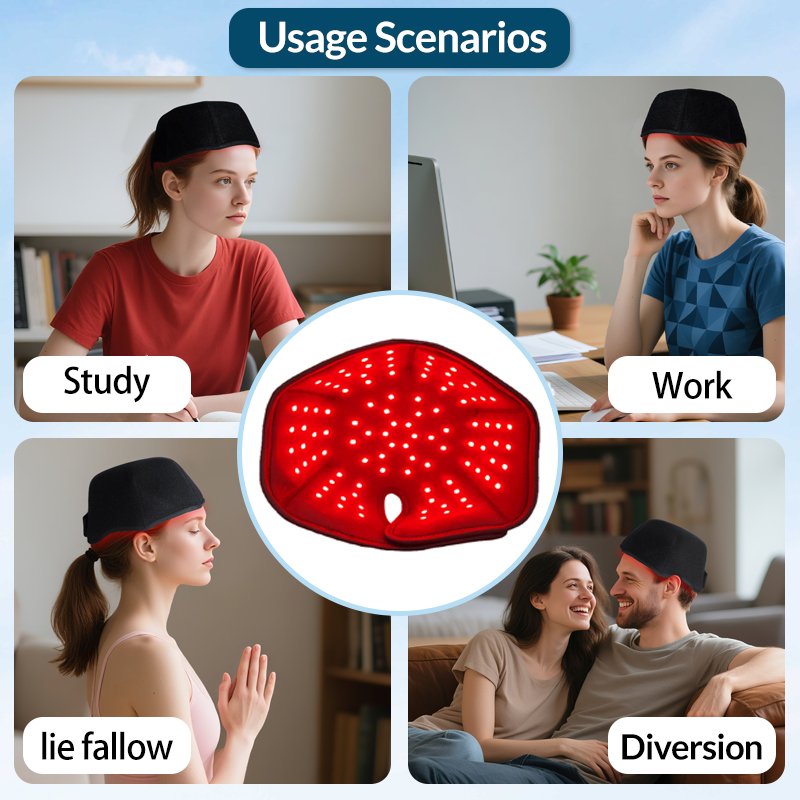
Red light hair growth caps are somewhat helpful in alleviating hair loss problems, but the impact of individual suitability and usage standards cannot be ignored. As a non-invasive red light therapy (also often referred to as low-level laser therapy), its core principle is to use red light of a specific wavelength between 630-670 nanometers to act on scalp hair follicle cells, thereby activating mitochondrial function, accelerating metabolism and blood circulation in the hair follicle area, and achieving the auxiliary effect of delaying the hair loss process and aiding hair regrowth. According to existing clinical research data, such products may have a certain improvement effect on common hair loss types such as androgenetic alopecia and telogen effluvium, but the final effect will vary significantly due to factors such as individual physical constitution and the degree of hair loss.
Frequently Asked Questions About Red Light Hair Growth Cap
I. Core Working Principle
The core function of the red light hair growth cap lies in the biological stimulation effect of red light energy: when red light penetrates the scalp and reaches the hair follicle area, it will be efficiently absorbed by hair follicle cells. This process can promote the production of adenosine triphosphate (ATP) in cells — ATP, known as the “energy currency” of cells, its increased content can significantly enhance the nutrient delivery capacity of hair follicles, help extend the growth period of hair, and delay hair loss. At the same time, red light can also inhibit the production of inflammatory factors on the scalp, regulate the balance of the scalp microecology, and create a more suitable growth environment for hair follicles. It should be noted that this product has a more significant improvement effect on people with early hair follicle atrophy or mild hair loss.
II. Explanation of Actual Use Effect
From the perspective of actual use feedback, the effect of the red light hair growth cap requires a certain cycle. Usually, it is necessary to insist on using it for 3 to 6 months to observe obvious initial improvement, and the overall effective rate is roughly between 50% and 70%. As a physical therapy product, it is more suitable as an auxiliary means for hair loss improvement: if matched with regular hair growth drugs such as minoxidil, and combined with lifestyle adjustments such as regular work and rest and a reasonable diet, more ideal results can often be achieved. In addition, it should be clarified that this product cannot reverse completely closed hair follicles, and the improvement effect is relatively limited for people with severe hair loss (such as those with extensive hair follicle necrosis and severe scalp exposure).
III. Important Notes
1. Prioritize products that have obtained medical device certifications, such as Class II FDA certification, to ensure safety and effectiveness.
2. Control the usage duration and frequency properly: use for 10-30 minutes per session, 3-5 times a week. Avoid excessive irradiation to prevent potential damage to the scalp.
3. During the treatment period, it is necessary to maintain regular scalp cleaning and minimize physical damage to the hair and scalp, such as reducing hair pulling.
IV. Risk Tips & Aesthetic Considerations
Red light therapy is generally of high safety, but some people may experience side effects such as dry scalp and transient itching. From an aesthetic perspective, it is recommended to ensure even coverage of the hair part area during use, so as to avoid irregular distribution of newly grown hair caused by uneven irradiation. During the treatment period, scalp massage can be combined to promote absorption, but the strength must be controlled to prevent mechanical hair loss.
Hair loss often goes hand in hand with psychological stress, but it’s important to understand that hair growth naturally follows a cyclical pattern of ups and downs. There’s no need to feel overly anxious about a temporary increase in shedding.
It is recommended to first use a dermoscope examination to accurately identify the specific type of hair loss, and then formulate a customized improvement plan based on the results. During the conditioning period, maintain a regular daily routine, ensure a balanced intake of protein and B vitamins in your diet, and try to avoid damaging styling practices such as high-temperature perming and frequent dyeing and perming, which can harm both hair follicles and strands.
Even if no significant improvement is observed in the short term, there is no need to spiral into anxiety. Modern aesthetic medicine technologies have advanced considerably and can offer a variety of targeted solutions. The key lies in finding a conditioning and treatment approach that suits your own physiological state, and improving hair loss problems step by step.