Direct Source for Custom Red Light Therapy Mask | Full OEM/ODM
We are a certified factory specializing in professional-grade beauty tech – from Photon Beauty Face Masks to Handheld Photonic Beauty Wands. ✅ Fast delivery – streamlined production & logistics ✅ Medical-grade compliance – ISO13485, MDSAP, BSCI ✅ High-level customization – design, spectrum, materials, branding No middlemen. Just reliable B2B manufacturing for serious brands.
LED Face Mask for Men: What to Look For, Where Used & How to Use One
By David Chen (Biomedical Researcher) | Updated: September 2026
David Chen holds a Master of Science in Biomedical Engineering and has spent the past decade reviewing photobiomodulation research and LED device design for clinical and consumer applications.
An LED face mask for men is not a different technology from any other LED mask. It uses the same red and near-infrared light, the same 10 to 20 minute sessions, and the same gradual timeline. What actually changes is the buying decision, because jaw coverage, nose-bridge fit and beard length decide whether the mask does its job on a male face.
I review LED device design for a living, and I check shell geometry before power specs. A 2014 controlled trial in Photomedicine and Laser Surgery had 34 participants use red and near-infrared light over a series of sessions and measured higher collagen density by the end of the study. That result depends on the light staying where it is aimed. Slide a rigid mask 1 or 2 cm down a wider jaw and half the session lights the chin while the cheeks miss the exposure.
What Is an LED Face Mask for Men?
An LED face mask is a curved shell lined with light-emitting diodes that sits across the forehead, cheeks, nose and chin. You wear it for a set session time while the emitters deliver red light at roughly 630 to 660 nm and, in many models, near-infrared light at 810 to 850 nm. Researchers call the underlying process photobiomodulation: cells absorb specific wavelengths of light, and that absorption supports normal cellular energy production.
None of the mechanism is gender-specific. The reason a men’s version of the question exists is geometry. Adult male faces are on average wider through the jaw, and many men carry facial hair. A mask built around a narrower shell sits high on the face and leaves the lower half outside the emitter field. That is not a technology problem; it is a coverage problem, and coverage is exactly what the shell design controls.
Red and Near-Infrared: What Each Wavelength Band Does
Wavelength controls how deep light travels, so it is the first spec to check on any mask. Red light around 630 to 660 nm works in the surface layers of skin, while near-infrared at 810 to 850 nm reaches deeper tissue. Most face masks ship one band or both, and the difference matters more than the total number of LEDs.
Wavelength band
Approximate depth
Typical use on the face
Red 630-660 nm
Surface to about 2-3 mm
Skin tone, fine lines, everyday facial care
Near-infrared 810-850 nm
Up to about 5-10 mm
Deeper tissue work and recovery-style devices
Combined red and NIR
Surface plus deeper tissue
All-round masks and small panels
For a device that stays on the face, red is the workhorse band. If a listing prints only one wavelength and it sits outside the 630 to 660 nm range, treat the product with suspicion rather than excitement. Combined units add near-infrared for people who also move the mask down to the neck or lower jaw after a facial session.
The Fit Checklist: Jawline, Nose Bridge and Beard Length
Most masks claim one size fits all, but shells vary a lot. Three points decide whether a mask holds position on a man’s face:
Jaw and chin coverage. Hold the mask against your face before you commit. A shell sized for a smaller face stops above the jawline and leaves the lower cheek without light. Flexible silicone versions wrap over a wider jaw, while rigid shells need a closer match.
Nose bridge and eye opening. The shell should follow your bridge without hard pressure and keep the eye area covered by the built-in shield. If the mask presses on the bridge, a 15 minute session turns uncomfortable inside 5 minutes, and the device ends up in a drawer by week two.
Beard and stubble. Hair scatters light, so a full beard absorbs most of the exposure before it reaches the skin. That does not make the mask useless; it means the device works best on clean-shaven skin or short stubble, and covered zones will not receive the same dose as bare skin.
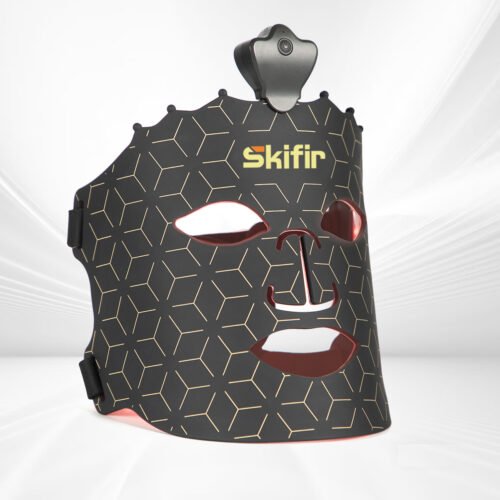
The photo above shows the geometry to look for: a contoured panel that follows the forehead and cheekbones while the eye area stays shielded. If a mask cannot hold that position for a full session, the wavelength list on the box is just marketing.
What a Realistic Weekly Routine Looks Like: 10-20 Minutes, 4-7 Sessions
Most home protocols sit between four and seven sessions per week at 10 to 20 minutes each, and consistency beats intensity. I would start at the lower end: five sessions of about 12 minutes, at roughly the same time each day. Evening works well for most men because the mask pairs naturally with the end of a shower routine on clean, dry skin.
If you shave, the sequence matters. Shave first, let the skin settle, then run the session, or run the session the following morning. Skip open cuts and active razor irritation. Keep the shell clean; silicone wipes down in seconds and a dirty surface quietly reduces output.
Manage expectations with a timeline. Expect little before the 4 week mark; published trial periods typically run 8 to 12 weeks, so evaluate the routine at the 12 week point rather than after a handful of sessions.
How to Choose a Men’s LED Face Mask Without Overpaying
Prices for the same basic idea range from a few dozen to a few hundred dollars, so anchor the decision to five checks. If you want a broader view first, the guides inside our red light therapy mask category compare fit, wavelengths and realistic prices side by side.
Printed wavelengths. Confirm 630 to 660 nm for red light, then decide whether near-infrared at 810 to 850 nm matters for how you plan to use the device.
Fit class. Silicone contoured shells suit wider jaws and stubble better; rigid shells reward a precise match to your face.
Emitter layout, not just count. A mask with more LEDs but gaps over the cheeks and jaw still misses zones. Check where the emitters sit relative to your face.
Session controls. A timer and auto-off remove the guesswork, and the eye shield should be genuinely opaque.
Regulatory status. In the United States, an LED light therapy mask can carry FDA clearance through the 510(k) pathway. The current Skifir 5D model, for example, holds FDA clearance number K251667, which means the design went through the FDA 510(k) review as an LED light therapy mask. Our red light therapy face mask walkthrough covers that shell in detail.
One note on claims: an ad promising overnight results is marketing; both the clearance and the research describe gradual, consistent use. If you prefer a cord-free routine, our rechargeable at home red light therapy mask puts the same wavelengths in a flexible shell you can wear while moving around.
Frequently Asked Questions
Is an LED face mask for men different from a women’s mask?
The light and the mechanism are the same. The practical difference is fit: men’s faces are typically wider through the jaw and may carry facial hair, so a contoured shell with lower-face coverage and room around the nose is the better match. Buy on geometry, not on gender labels.
Will an LED face mask work if I have a beard?
Light does not pass easily through thick hair, so a full beard absorbs most of the exposure before it reaches the skin. The mask still works on exposed areas such as the forehead, nose and upper cheeks. For covered zones, treat clean-shaven skin or short stubble as the effective session area.
Should I use the mask before or after shaving?
Use it on clean, dry skin. If you shave in the morning, run the session in the evening once razor irritation settles, or wait until the next day. Skip open cuts and actively irritated skin.
How long and how often should a session be?
Most home guidance lands at 10 to 20 minutes per session, four to seven times a week. Start at the lower end, around five sessions of 12 minutes, and keep the timing consistent.
How long until I see a difference?
The research protocols typically run 8 to 12 weeks, and most people notice little before the 4 week mark. Judge the routine at 8 to 12 weeks of consistent sessions rather than after a few uses.
Does the mask hurt or get hot?
No. The light produces mild warmth at most. Keep the eyes shielded as the device directs, follow the session timer, and stop if the fit creates pressure points.
References
Hamblin MR. Mechanisms and applications of the anti-inflammatory effects of photobiomodulation. AIMS Biophysics. 2017.
Wunsch A, Matuschka K. A controlled trial to determine the efficacy of red and near-infrared light treatment in phototherapy. Photomedicine and Laser Surgery. 2014.
Weiss RA, McDaniel DH, Geronemus RG, et al. Clinical trial of a novel non-thermal LED array for reversal of photoaging. Lasers in Surgery and Medicine. 2005.
Barolet D. Light-emitting diodes in dermatology: an update on cellular mechanisms and clinical applications. Seminars in Cutaneous Medicine and Surgery. 2008.
Jagdeo J, Austin E, Mamalis A, Wong C, Ho D, Siegel DM. Light-emitting diodes in dermatology: a systematic review of randomized controlled trials. Lasers in Surgery and Medicine. 2018.
Free Shipping & Fast Delivery
Reliable, trackable, and worry-free.
Safe and Secure Payment
Pay worry-free with PayPal or credit card.
24/7 Dedicated Support
Round-the-clock dedicated support, because your success is our priority.
Money back guarantee
Return or exchange for any reason within 60 days of delivery.